
Garage Door Repair: Repair or Replace? How Delaware Homeowners Decide
A 15-year-old door with a broken spring is almost always worth repairing. A 10-year-old door with a cracked bottom section and bent tracks might not be. Age is the wrong number to focus on. The repair-or-replace call comes down to which parts have failed and whether the door’s structure can carry new hardware for another decade. That’s the whole decision in one sentence, and it’s not the one most homeowners are handed.
In our experience, homeowners in Delaware get pushed in both directions. Some are sold a full replacement for a problem a new spring would have solved. Others are talked into a repair that won’t hold because the frame underneath is already giving out. Neither is fair. If you’d rather not sort through it alone, call (833) 509-5064. We answer 24/7. Fast dispatch from 7am to 7pm, Sunday through Friday.
Key Takeaways
- Age alone rarely decides it. Failed components and structural condition do.
- New springs, cables, and an opener on a sound door often cost a fraction of a full replacement.
- Cracked bottom sections, bent tracks, and a sagging header change the math fast.
- A written estimate should list exactly which parts get replaced and which get re-used.
What Should a Technician Check Before Quoting Repair or Replacement in Delaware?
An honest assessment checks the whole door, not just the part that’s making noise. Before anyone quotes you a repair or a replacement in Delaware, they should walk the full system: springs, cables, rollers, hinges, tracks, panels, and the opener. If a quote comes back in five minutes without that walk, you’re getting a guess with a price tag on it.
Here’s what that structural check should cover, and what to ask about if it doesn’t:
- Track alignment and plumb. Are the vertical tracks straight and securely anchored, or pulling away from the jamb? Warped tracks punish every new part you put in them.
- Panel condition, inside and out. A door can look fine from the driveway and be cracked or rusted through on the back side. Ask them to check both faces.
- Hinge and roller wear. Slotted or egg-shaped hinge holes mean the door is moving more than it should. That stress transfers to the opener and springs.
- The header and jamb. Is the wood the door hangs from solid, or soft and splitting? New hardware bolted to a failing header won’t stay put.
- Balance test. A door should hold roughly halfway open when you let go. If it slams or drifts, the spring tension is off or the springs are spent.
- Opener condition and age. A tired opener on a door that’s about to get heavier hardware needs to be part of the conversation, not an afterthought.
Ask direct questions. “Which parts are you replacing, and which are you keeping?” “Did you check the header?” If the answers are vague, get a second opinion. That’s not being difficult. It’s being smart about a several-hundred-dollar decision.
When Do New Springs, Cables, and an Opener Still Make Sense on an Older Door?
They make sense when the door’s panels, tracks, and frame are still solid. Springs and cables are wear items. They’re designed to fail and be replaced. Bolting fresh springs, cables, and a modern opener onto a structurally sound door can hand you years of quiet, reliable operation for a fraction of a new door, even if that door has some miles on it.
Think of it as component lifespan math. Every part on a garage door has a service life, and they don’t all expire together. Springs carry the most load and tend to go first. Cables follow. Openers usually outlast both. When only the wear items have failed and the door body is healthy, repair wins almost every time. We work on LiftMaster and Chamberlain openers every week, and a good chunk of those calls end with new hardware on a door that had plenty of life left.
The math flips when failures start stacking up. If you’re looking at worn springs, frayed cables, a struggling opener, and a door that’s out of balance, you’re pricing a rebuild of the whole system. At that point, compare the repair total against a replacement quote before deciding. Sometimes repair still wins. Sometimes it doesn’t. You just need both numbers in front of you.
Spring work is the one part of this we won’t dress up: high-tension springs and cables are genuinely dangerous. The tension stored in a wound spring can cause serious injury in an instant. This is not a job to take on with a ladder and a how-to video. Leave it to a trained technician. For a closer look at how we handle that side of the work, see garage door repair.
Which Panel Damage Thresholds Mean Repair Stops Being Viable?
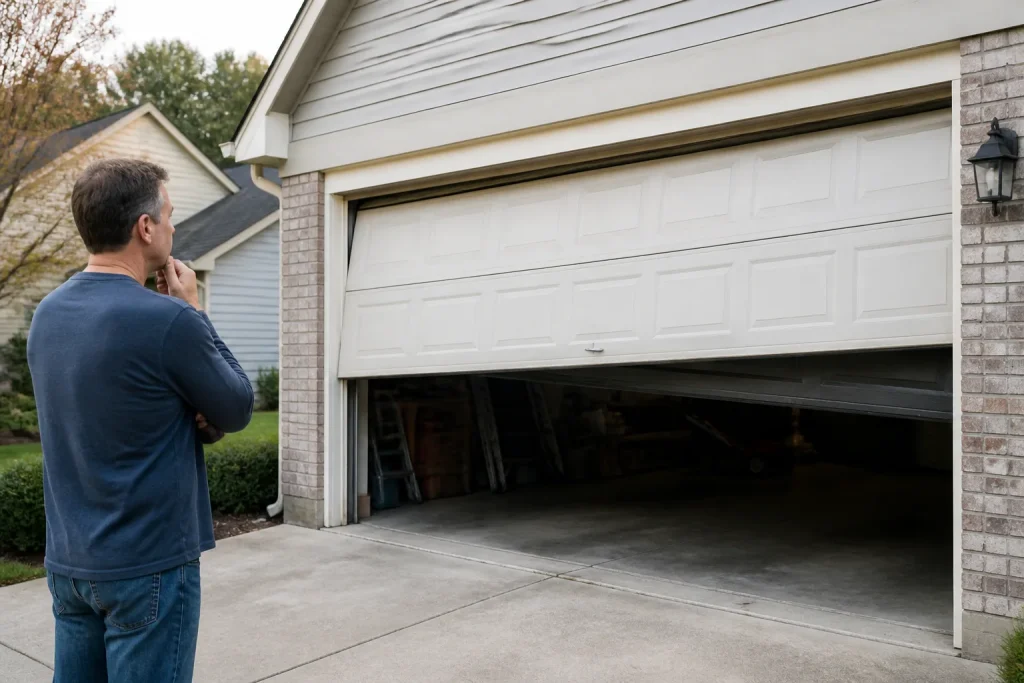
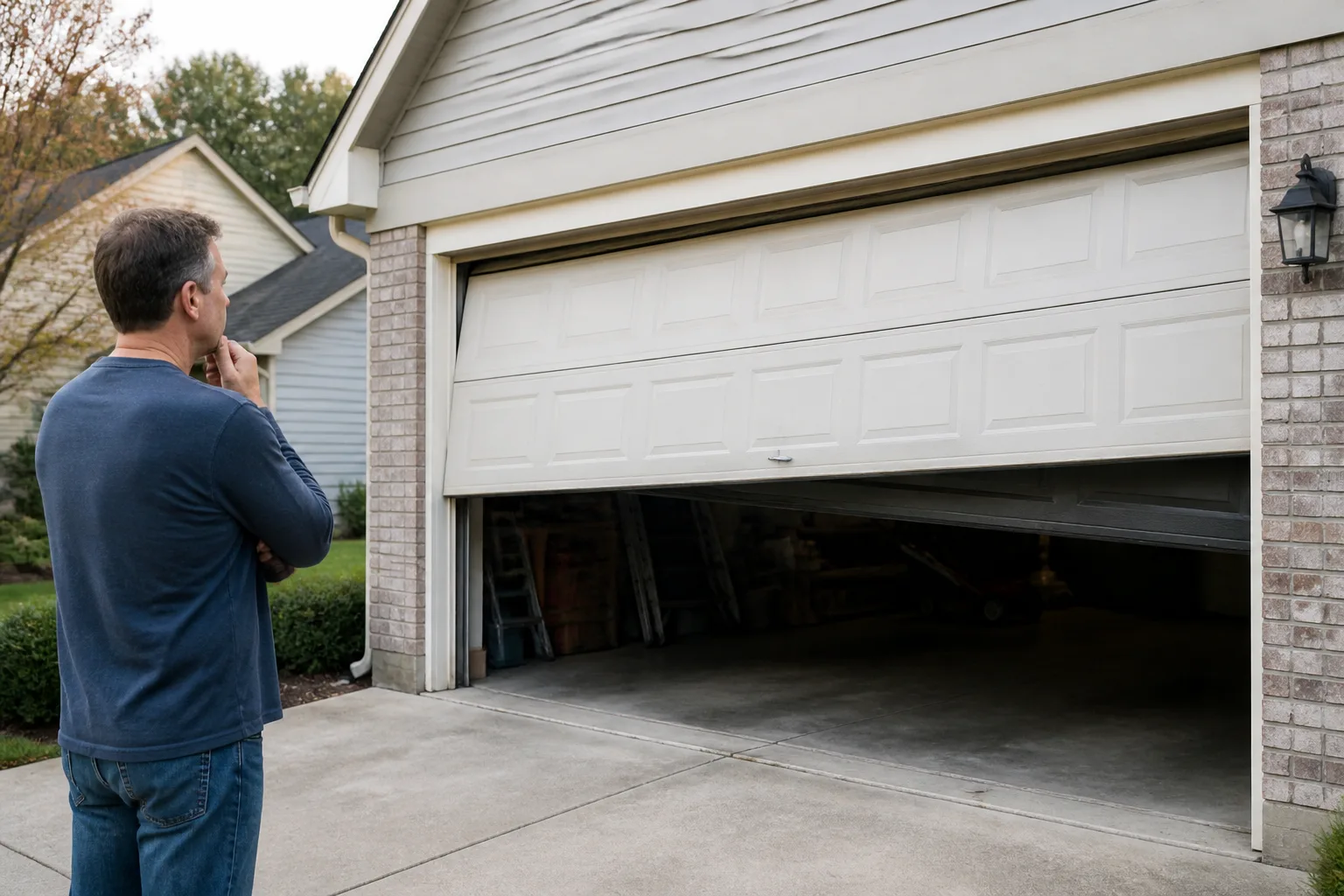
Panel damage crosses the line from cosmetic to structural when the door’s ability to hold its shape is compromised. Cosmetic is a dent or a scrape. Structural is a bottom section that’s cracked through, a panel that’s split along a seam, or a door that’s visibly sagging at one corner. Once a panel loses its integrity, it flexes under load, and flexing doors eat springs and burn out openers.
Watch for these thresholds in Delaware homes:
- Cracks through the bottom section. The bottom panel takes the most abuse and is the hardest to keep watertight once it’s cracked. That section is often a structural anchor, not just a pretty face.
- Splits along a panel seam. If the door is separating where sections meet, the whole stack is losing rigidity.
- Bent or bowed tracks. Tracks that won’t straighten without force are done. Force-straightening old tracks invites bigger problems.
- Sagging header or jamb. If the structure the door hangs from is failing, no panel repair will fix it. This is a carpentry problem, not a garage door problem.
- Multiple cracked panels. One panel is a repair. Three or four is usually a replacement conversation.
When you hit these thresholds, an honest technician will say so. That’s the diagnosis-first, repair-second approach we work by. We’d rather tell you the truth about a door that’s past saving than sell you a patch that fails in eighteen months.
How Do Insulation and Energy Performance Weigh In for Delaware’s Climate?
For an attached garage, insulation matters more than most homeowners realize. Delaware summers run hot and humid, and winters get properly cold. An uninsulated or poorly sealed door on an attached garage lets that swing straight into the rooms above and beside it. Insulation is one of the few upgrade decisions where replacement genuinely can beat repair over the long run.
Here’s how it factors into the repair-or-replace equation over roughly a ten-year window:
- Repair keeps the door you have. If your current door is uninsulated and the garage sits under living space, repairing it leaves that weak spot in place. You’ll spend every summer and winter paying for it in comfort and energy.
- Replacement can add insulation value. A new insulated door with a proper bottom seal and weatherstripping tightens the whole envelope. That’s a cost you can’t recoup through springs and cables.
- Seals and thresholds count. A door can be well insulated and still leak air at the bottom. New seals often cost far less than a new door and close a surprising amount of that gap.
- The ROI question is real. If you’re already facing a failed door and an attached garage, an insulated replacement often makes more sense than throwing money at an uninsulated old one.
If your garage is detached, this whole section matters far less. Insulation savings mostly evaporate when nothing conditioned shares a wall with the garage. Be honest with yourself about which garage you actually have. Lots of homeowners pay a premium for insulation they’ll never feel. If you’re weighing a replacement, our garage door installation page lays out what’s involved.
What Does a Full Replacement Actually Include, and What Gets Re-Used?
A full replacement should include the door sections, all hardware (hinges, rollers, springs, cables, and brackets), new tracks, and a thorough removal and haul-away of the old door. What gets re-used is usually the opener, if it’s in good shape and compatible with the new door’s weight, and that’s about it. If your quote leaves anything off that list, ask about it before you sign.
This is where homeowners get burned most often. You pay for a new door and end up with old hardware bolted to it. That old hardware is the first thing to fail. A few ways to verify you’re actually getting a new system:
- Read the line items. The estimate should spell out springs, cables, tracks, and rollers as new. If they’re missing, they’re probably being re-used.
- Ask about the opener. A new door is heavier or a different weight class than your old one. Make sure the existing opener can handle it or budget for a replacement.
- Check the warranty scope. Know what’s covered and for how long. A strong warranty on the door but a shrug on the springs is a red flag.
- Ask what happens to the old door. Removal and disposal should be included, not a surprise add-on.
Brands matter too, for parts and for warranty. If your door is a Clopay or a Raynor, the new door and its hardware should be matched to work together. If you’re keeping an existing opener, a LiftMaster or Chamberlain unit that’s still going strong can often stay. We work on your brand, and getting the match right is part of the job.
When to Call a Pro
You can safely check balance, look at panel condition, and test the opener yourself. When you’re dealing with springs, cables, or a door that’s off its track, stop. Those are the jobs where a small mistake becomes an emergency room visit. When your garage door stops working, so does your day, and that’s exactly when we’re set up to help. Call (833) 509-5064 for a free estimate. Same-day service is often available, and we quote the price and get your agreement before any work starts, so you never see an invoice bigger than the number you said yes to.
Related Services in Delaware
If your opener is the failing part, we handle garage door opener repair across the brands already in your garage. Everything we do starts at Garage Door Repair Delaware, where you can see the full range of what we cover.
The Bottom Line
Repair if the door’s body is sound and only wear items have failed. Replace if the structure, panels, or your climate needs point the other way. Age is a tiebreaker at best. The two numbers to get are the repair total and the replacement quote, and the only person who should be giving you either is a technician who’s actually assessed the door. Our technicians have up to 11 years of experience, and we’re factory-familiar with Craftsman, LiftMaster, Chamberlain, and the major door brands, so the assessment fits whatever is already hanging in your garage.
If you’re in Delaware and need help, Garage Door Repair Delaware offers free estimates. Call (833) 509-5064. We answer 24/7. Fast dispatch from 7am to 7pm, Sunday through Friday.
Frequently Asked Questions
Repair is almost always cheaper short-term, especially when only springs or cables have failed on a structurally sound door. Replacement costs more up front but can make more sense when multiple components have failed together or when an uninsulated door on an attached garage needs upgrading. Get both numbers and compare. Call (833) 509-5064 for a free estimate.
Age alone doesn’t make a door too old to repair. A cracked bottom section, splits along panel seams, bent tracks, or a sagging header are the signs that repair stops being viable. If the panels and frame are solid, new springs and cables can keep an older door running for years. Call (833) 509-5064 and we’ll assess it honestly.
It can, if the garage is attached to your home and the door is under living space. An insulated door with good sealing cuts heat transfer between the garage and the rooms above and beside it. On a detached garage, the savings are far smaller and often don’t justify the cost. Call (833) 509-5064 to talk through your specific setup.
The local pros we connect you with are licensed and insured as Ohio requires. Our technicians have up to 11 years of experience and work across LiftMaster, Chamberlain, Genie, Clopay, Amarr, Wayne Dalton, Craftsman, and Raynor. Call (833) 509-5064 for a free estimate with the price agreed before any work starts.
Written by the team at Garage Door Repair Delaware.
Need Garage Door Help?
Call Garage Door Repair Delaware - the local pro we connect you with is licensed and insured, here with fast help in Delaware.
(833) 509-5064