
Top Signs You Need Garage Door Service – Don’t Ignore These
A garage door that takes three seconds longer to open than it used to isn’t “just getting old” – it’s telling you a specific component is failing, and that component is about to take others with it. The signs are rarely subtle. Most homeowners just learn to live with them: the grind, the shudder, the door that reverses on its own, the remote you have to hold at just the right angle. Those workarounds are how small mechanical problems become expensive ones.
Below we walk through the warning signs we see most often, what each one actually means inside the door, and how to check it yourself in a few minutes. If you’d rather not crawl around with a flashlight, call (833) 509-5064 for a free estimate. We answer 24/7, with fast dispatch from 7am to 7pm.
Key Takeaways
- Slow or uneven movement is a mechanical symptom, not cosmetic wear.
- A door that reverses before closing is usually a safety sensor problem, not an opener failure.
- A 60-second balance test reveals weakening springs before they snap.
- Visible cable fraying and flat-spotted rollers predict the next few months of reliability.
- Noise tells you where the problem lives: rollers and hinges rattle, springs and cables pop and twang.
1. The Door Moves Unevenly, Shudders, or Binds
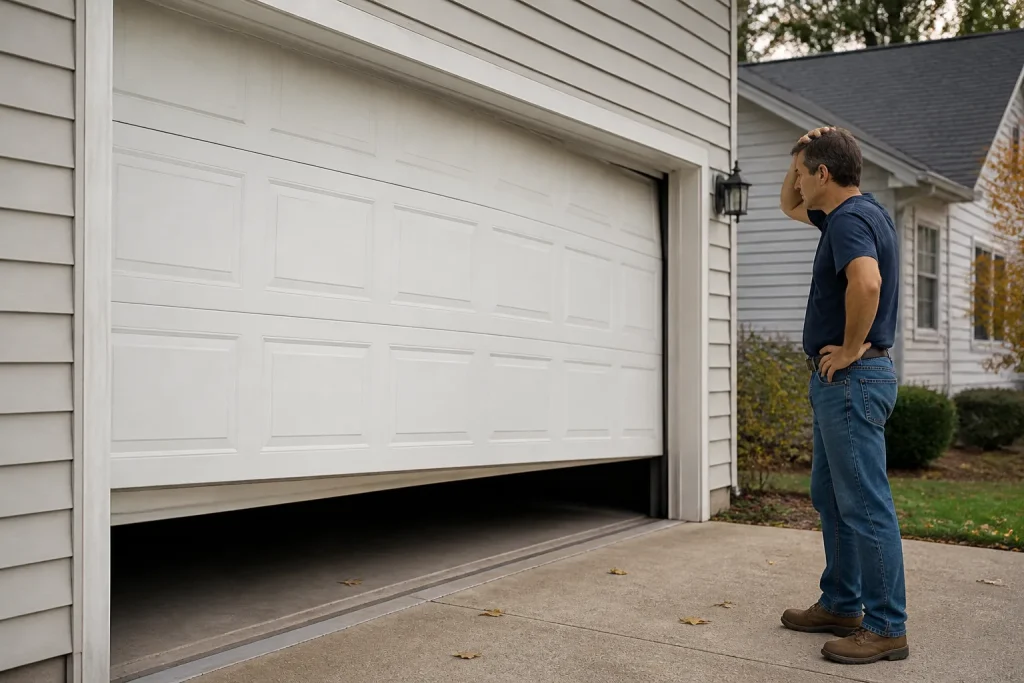
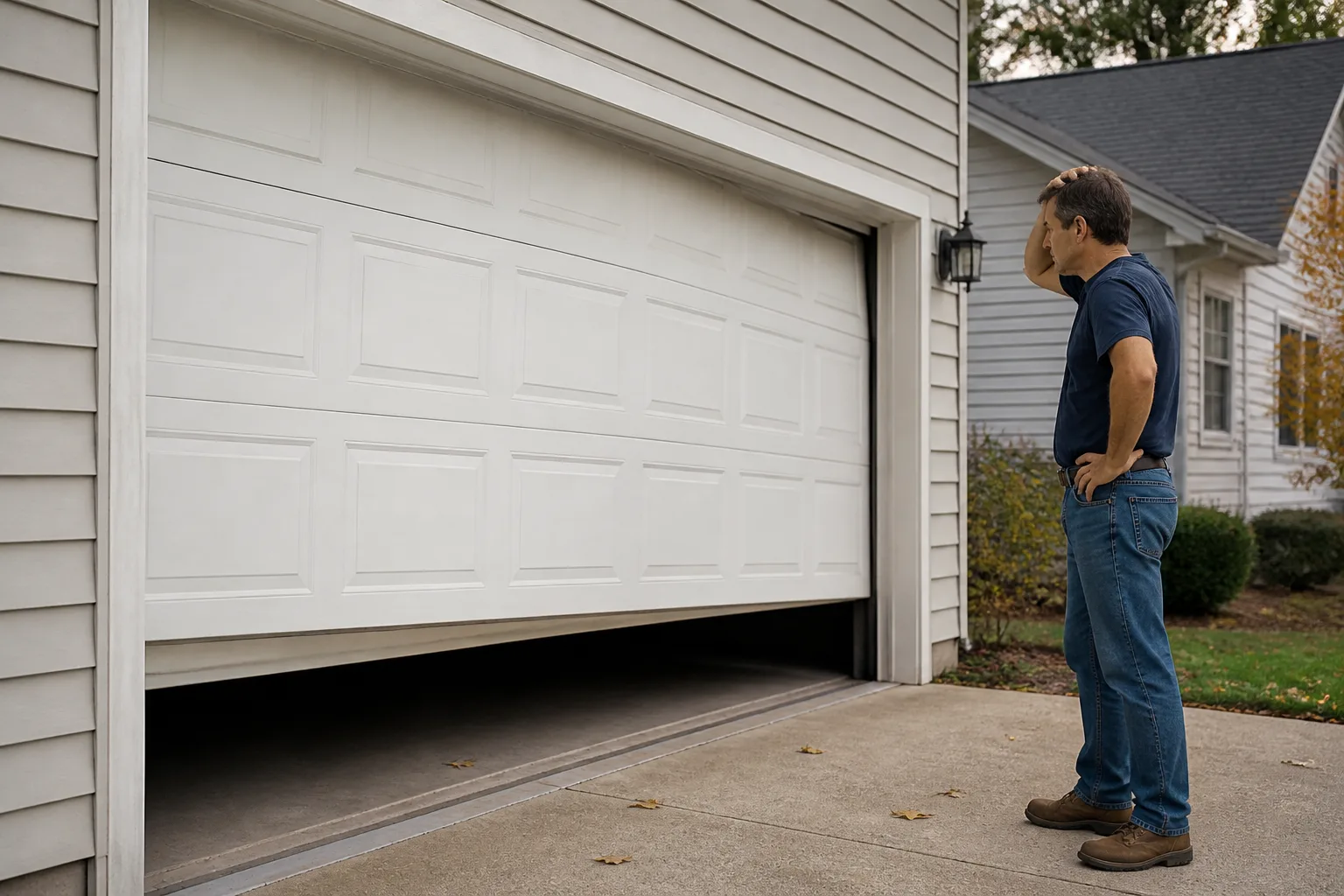
An uneven garage door is almost never an alignment problem you can fix by nudging a track. When a door lifts crooked, hesitates halfway, or shudders on the way up, the cause is mechanical load imbalance. One side is doing more work than the other, and something is letting it happen.
The usual suspects, roughly in order of what we find on a diagnostic call:
- One spring has weakened ahead of the other. Torsion systems use two springs, and they don’t wear at the same rate. A door with one tired spring rises cocked, then leans into the good side.
- A stretched, slipping, or partially frayed cable. Cables are under serious tension and wrapped on a drum. When one starts to give, the door sags on that corner.
- A bent track or a popped roller. A roller that’s jumped its track or worn flat will jam in the same spot on every cycle, which is why the door hangs there every time.
- A weak or failing opener. If the motor labors audibly and the door runs smoothly by hand, the opener is the weak link and the door hardware may be fine.
This is the sign homeowners wait out longest, and it’s the one that does the most collateral damage. A door running crooked stresses the hinges, rollers, and opener drive gear on every cycle. What starts as a spring replacement can turn into tracks, cables, and an opener. Any Delaware homeowner seeing consistent uneven travel should get it looked at before the mechanism finds its own solution. We handle garage door repair for exactly this kind of problem, and diagnosis comes before we touch a tool.
2. The Sound Profile Has Changed – Listen Before You Look
Your garage door has a sound baseline. You hear it every morning without thinking about it. When that baseline changes, the tone of the noise tells you where to look.
Rattling, squeaking, or a dry metallic scrape usually means rollers, hinges, or the torsion bar itself. This is the benign end of the spectrum: dry or worn rollers rolling badly, hinges that need a drop of lubricant, nylon rollers that have gone flat. A Clopay or Amarr steel door that’s been up for years will rattle at the hinges long before anything fails.
A sharp pop, a twang, or a bang followed by silence is a different animal. That’s a spring under load releasing. With torsion springs it’s usually a loud snap that can sound like a firecracker. With extension springs it’s a stretch and twang. If you hear that and the door suddenly becomes dead weight or won’t lift at all, a spring has failed. Stop operating the door and keep clear of it.
A grinding that pulses with the door’s travel points to the opener: a worn drive gear, a slipping belt, or a stripped trolley carriage. LiftMaster and Chamberlain chain and belt drives usually give a low grinding whine; Genie screw drives sometimes develop a growl. If the noise comes from the motor housing rather than the door, you’re looking at garage door opener repair, not door hardware.
You don’t need to diagnose it yourself. You just need to notice that it’s different and say so when you call. “It rattles at the top left hinge” saves a technician ten minutes and gets you to the right fix faster.
3. The Door Reverses Before It Closes
A door that bounces back up before closing is a safety sensor issue until proven otherwise. It is not an opener glitch, and it is not a remote problem. The opener is doing exactly what it’s designed to do: detecting an obstruction and reversing to avoid crushing whatever’s in the way.
The sensors are the two small units at the bottom of the tracks, one on each side. One shoots an infrared beam; the other receives it. When the beam is broken, the door reverses. This is the safety system working correctly. What usually happened:
- The alignment is off. Something bumped a sensor bracket, or the sun hits the receiving eye at a low angle and washes out the beam.
- There’s debris in the path. Spiderwebs, leaves, or a forgotten hockey stick between the sensors will do it.
- A sensor has failed. The indicator light on the receiving unit will normally tell you. A steady light means the beam is clear; a blinking or dark light means it’s compromised.
- Force settings have drifted. On older openers, the force adjustment can loosen over time and trigger a false reversal.
Craftsman and Genie units we see in Delaware garages often trip on dirty lenses before anything actually fails. Start by wiping both lenses and checking alignment with a level. If the door still reverses, leave it to a technician. The reverse mechanism is the one system in your garage that exists to prevent injury, so it deserves a proper check, not a workaround. Our technicians have up to 11 years of experience on exactly these systems.
4. The 60-Second Balance Test – Catch Weak Springs Before They Fail
Springs are the component most likely to strand your car, and most failures are predictable weeks in advance. The balance test catches that wear early. It takes about a minute and doesn’t require tools.
How to run it (safely):
- Close the door fully and pull the red emergency release handle to disconnect the opener.
- Lift the door by hand to about halfway, then let go. Don’t force it.
- A properly balanced door should stay put, more or less, at the halfway point.
- If the door drops slowly on its own, your springs are losing tension.
- If it slams down, or you can barely lift it, the springs are significantly weak.
Then re-engage the opener and open and close the door once to reset the carriage.
A door that won’t hold its position means the springs are carrying less load than they should, and the opener is picking up the difference. That’s why weak springs so often come with a burnt-out motor a few months later. Spring repair is the one part of this work that’s never a do-it-yourself job. Torsion springs are under extreme tension even when they look relaxed, and a winding bar slipping out of a spring is genuinely dangerous. Trained professionals have the right bars, the right technique, and the right respect for the spring. It’s the reason we treat spring repair as a dedicated service rather than an add-on.
5. The Visual Checks That Predict the Next 90 Days
You don’t need to disassemble anything. A flashlight and five minutes in front of the door will tell you a lot.
- Look at the cables. They run from the bottom corners up along the track to the drum. They should be smooth and tightly wound. Any fraying, kinks, or “bird-caging” (loose wires spiraling off the core) means the cable is on borrowed time. Don’t touch it; just note it and mention it when you call.
- Run a finger along the rollers. Each roller should turn freely and feel smooth. Flat spots, wobble, or visible cracks in the nylon wheel mean they’re due. A Clopay door in Delaware sun will cook its rollers faster than you’d expect.
- Check the hinges for looseness or rust. Hinges wear at the pivot point, and a loose hinge lets the door sag between sections.
- Sight down each track. The gaps should be even along the entire run, and the track should look plumb. Dents or misalignment from a bumper tap are easy to spot.
- Look at the springs themselves. A visible gap in a torsion spring coil, or a spring that looks loose or sagging, means a failure is close.
If any of these checks turns up problems, a call now is cheaper than a call after the door fails. For a full replacement on an old, worn door, we handle garage door installation as well, so you’re not bouncing between companies.
6. When to Call a Pro, and What to Say
You should call a professional when the problem involves springs, cables, or the door coming off the track. Those three carry real injury risk, and they’re the parts most commonly mishandled. You can safely handle lubrication, sensor lens cleaning, and visual inspection. Everything else is worth a diagnostic call.
When you call, tell us three things: what the door is doing (uneven, reversing, noisy), when it started, and whether the door is stuck open or closed. If you’re in a locked or unsecured situation, say so. We offer emergency garage door service for failures that trap a car or leave a home unsecured, and the phones are staffed when the door won’t wait.
Related services in Delaware: garage door repair for tracks, panels, and hardware; garage door opener repair for motors and safety sensors; spring repair for the most urgent failures; and installation for a door past its service life.
One note on brand: we work on your brand, not a house brand. Our technicians service LiftMaster, Chamberlain, Genie, Clopay, Amarr, Wayne Dalton, Craftsman, and Raynor, so your existing door and opener don’t need replacing just because a tech doesn’t know them.
The Bottom Line
Most of the signs above are telling you the same story: a load-bearing component is wearing down, and the rest of the system is compensating. Uneven movement, a changing sound, a door that reverses, a weak balance test, and frayed cables all point to predictable failures you can get ahead of.
The cheapest repair is always the one you catch early. If you’re in Delaware and want a straight answer about your door, Garage Door Repair Delaware offers free estimates. Call (833) 509-5064. We answer 24/7, with fast dispatch from 7am to 7pm, Sunday through Friday, and we’re closed Saturday. If you reach us outside dispatch hours, we’ll book you into the next opening.
For a full picture of what we do, see Garage Door Repair Delaware. Diagnosis comes first. The written estimate sets the final price before any work starts.
Frequently Asked Questions
A change in how the door moves or sounds is the first sign: uneven travel, a shudder, or noise where there used to be none. Those symptoms show up before a failure, not after. If your door has developed any of them, call (833) 509-5064 for a free estimate.
Yes. Lubricating rollers, hinges, and tracks is safe homeowner maintenance and can quiet a rattling door. Use a garage-door lubricant, not household oil or WD-40, and avoid the tracks themselves beyond a light wipe-down. Spring and cable work is not a do-it-yourself job. Call (833) 509-5064 if the noise doesn’t quiet down.
The balance test is the clearest sign: if the door won’t hold halfway by hand, the springs are weakening. A visible gap in the torsion spring, or a door that’s gotten noticeably harder to lift, confirms it. Don’t try to fix it yourself. Call (833) 509-5064 and we’ll send a technician.
Most repairs take about an hour once the technician is on site. Spring, cable, and roller repairs usually fall in that range. Opener diagnostics and full panel replacement can take longer depending on the part. A free estimate gives you the scope and the price before work begins. Call (833) 509-5064 and we’ll book a time that works.
Written by the team at Garage Door Repair Delaware.
Need Garage Door Help?
Call Garage Door Repair Delaware - the local pro we connect you with is licensed and insured, here with fast help in Delaware.
(833) 509-5064